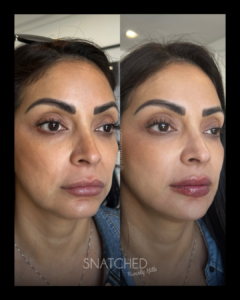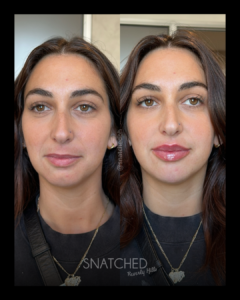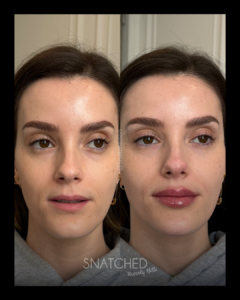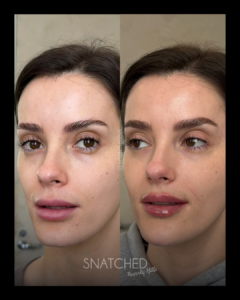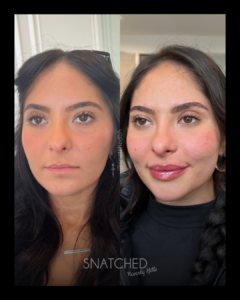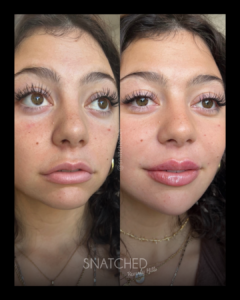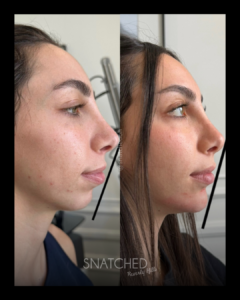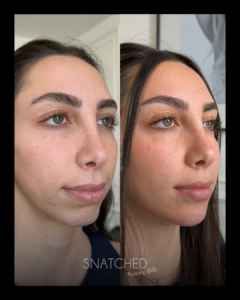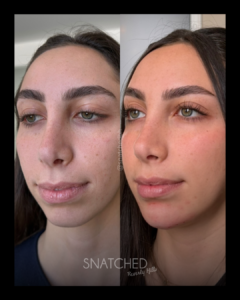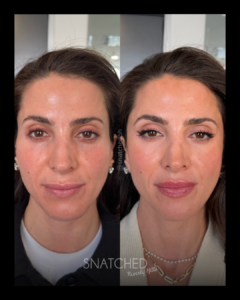

Dissolving filler sounds simple. You go in, the provider injects hyaluronidase, the product breaks down, and you start with a clean slate. That is how it is often described, and that description is not entirely wrong. But it leaves out a significant amount of information that matters enormously if the goal is a result you are genuinely happy with after the reset.
At Snatched Beverly Hills, master injectors Ani Malkhasyan and Sadiyah Karimi see patients regularly who have had filler dissolved elsewhere and are frustrated that they still do not look right. The dissolve was performed, but the next step was not planned thoughtfully. The tissue was not given adequate time to recover. The rebuild did not account for what the natural anatomy actually looked like. The same decisions that led to the original problem were made again, just with a fresh start.
This guide is for patients who are considering dissolving their filler and want to do it correctly from the beginning.
When Dissolving Is the Right Decision
Not every patient who is unhappy with their filler needs to dissolve everything. There are situations where targeted correction, repositioning, or the addition of product in a different area can address the problem without a full reset. An experienced provider assesses these options before recommending dissolution.
Dissolving is generally the right decision when:
Filler has migrated significantly above the vermillion border of the lips, creating puffiness or blurring that cannot be corrected by adding product elsewhere.
The cumulative volume of product in an area is too high to correct with additional treatment, meaning the foundation itself needs to be cleared.
The patient has developed an allergic reaction, chronic inflammation, or biofilm-related complications with an existing filler.
The patient wants to return to their natural anatomy and assess what they are actually working with before deciding whether to replace any product at all.
The original treatment was performed with a permanent or semi-permanent filler, or with a product that is not behaving predictably in the tissue.
What Hyaluronidase Does and Does Not Do
Hyaluronidase is an enzyme that breaks down hyaluronic acid by cleaving the molecular chains in the HA gel. It does this quickly and effectively in most cases. When injected near or into a HA filler deposit, it begins working within hours and the full breakdown typically occurs over 24 to 72 hours.
What most patients are not told is that hyaluronidase does not distinguish between injected filler and the body’s own native hyaluronic acid. Native HA is present throughout the skin and contributes to natural hydration, plumpness, and tissue integrity. When hyaluronidase is used in excess amounts or placed carelessly, it can dissolve native HA along with the injected product, leaving the tissue temporarily more deflated than it was before any filler was ever placed.
This effect is temporary. The body replenishes its own HA over a period of weeks. But patients who are not warned about it sometimes panic when they see their lips or cheeks immediately after dissolving and feel they look worse than before. Understanding that this is a normal, temporary phase of the process prevents unnecessary distress and premature decisions to replace product before the tissue has fully recovered.
At Snatched Beverly Hills, the amount of hyaluronidase used is calibrated carefully to the estimated volume and location of existing product. This minimizes collateral effect on native tissue while still achieving complete dissolution of the injected filler.
The Recovery Timeline After Dissolving
Patients often underestimate how much time the tissue needs between a dissolve and a rebuild. Rushing this process is one of the most common reasons a corrective treatment produces disappointing results.
In the first 24 to 48 hours after dissolving, swelling is present from the hyaluronidase injection itself. The area may look uneven, lumpy, or more deflated than expected. This is not the final result.
Over the following three to five days, swelling resolves and the breakdown of the dissolved product continues. The tissue begins to look more like its natural state, though some residual puffiness may remain.
By two weeks, most of the dissolved product has been metabolized and the tissue is approaching its natural baseline. For lips specifically, the full natural anatomy is often most clearly visible at the four to six week mark, after any residual product has completely cleared and the tissue has had time to normalize.
Ani Malkhasyan and Sadiyah Karimi at Snatched Beverly Hills typically advise patients to wait a minimum of four weeks before rebuilding, and often six weeks in cases of significant volume or long-standing product. This is not a delay for the sake of caution. It is a clinical decision based on achieving the most accurate assessment of the natural anatomy before any new treatment decisions are made.
What Your Natural Anatomy Looks Like Without Filler
One of the most valuable parts of the dissolving process, when approached correctly, is the opportunity to see and understand what your natural anatomy actually looks like. Many patients who have had filler for several years have genuinely lost track of what their lips, cheeks, or under-eye area looked like before treatment.
This matters because a good rebuild is not simply about replacing what was dissolved. It is about understanding the natural architecture and making deliberate, precise additions that enhance it rather than override it. Providers who skip this assessment phase and immediately rebuild often recreate the same imbalances as the original treatment, simply with fresh product.
At Snatched Beverly Hills, the post-dissolve consultation is as important as the initial one. The team assesses what the natural anatomy reveals, identifies which structural elements would benefit most from precise enhancement, and builds a treatment plan that starts with the minimum and adds only what actually improves the result.
Questions to Ask Before Choosing a Provider for Your Dissolve
Not every provider who offers dissolving is equally qualified to perform a thoughtful reset. These are the questions worth asking before booking:
How will you assess how much product is currently present and where it has distributed? A provider who intends to simply inject hyaluronidase without any prior assessment of existing product distribution is not approaching the procedure with adequate precision.
How much hyaluronidase will you use, and how will you determine that amount? The dose matters. Both insufficient and excessive dosing create problems.
What is the recommended wait time before rebuilding, and what is the rationale? An answer of one or two weeks should prompt further questions.
Will you do a consultation before the rebuild to assess the natural anatomy, or will you proceed directly from dissolve to reconstruction in the same appointment? Same-day dissolve and rebuild does not allow for accurate tissue assessment.
Can you show me before and after results specifically for correction cases? A provider’s general portfolio of beautiful lip work does not tell you whether they have the specific experience needed for corrective cases.
The Role of the Snatched Technique in Corrective Work
The Snatched Technique, developed by Ani Malkhasyan and Sadiyah Karimi, is an anatomy-first, precision-driven approach to non-surgical facial treatment. Its application to corrective lip work reflects the same principles: assess first, treat with intention, use the minimum product required to achieve the desired result, and build a plan that supports the patient’s long-term goals rather than simply addressing the immediate complaint.
Patients who come to Snatched Beverly Hills for corrective work frequently comment that the consultation alone changed how they understood their own lips. The team explains what they are seeing, why the original result looks the way it does, and what the correction process will involve at each stage. This transparency is not incidental. It is part of how the practice operates.
Corrective work is some of the most technically demanding work in aesthetic medicine. It requires not only skill in dissolving and rebuilding but also the judgment to know when to do less, when to wait, and when to tell a patient that their natural lips are the best outcome available.
Beginning the Process at Snatched Beverly Hills
Snatched Beverly Hills operates on a New Client Application basis. Patients who are interested in Lip Rehab or corrective filler dissolving begin by completing the application at snatchedbh.com and submitting photos of their current lips and any before photos they have from prior to filler treatment.
The team reviews every application personally. If you are a candidate for the Snatched Lip Rehab protocol, you will be contacted to schedule a consultation at the Beverly Hills suite.
If your filler is not right and you are ready to start over correctly, this is where that process begins.
144 S Beverly Dr, Suite 302, Beverly Hills, CA 90212
(310) 666-0303 | in*******@********bh.com | @snatchedbh
Before & Afters